
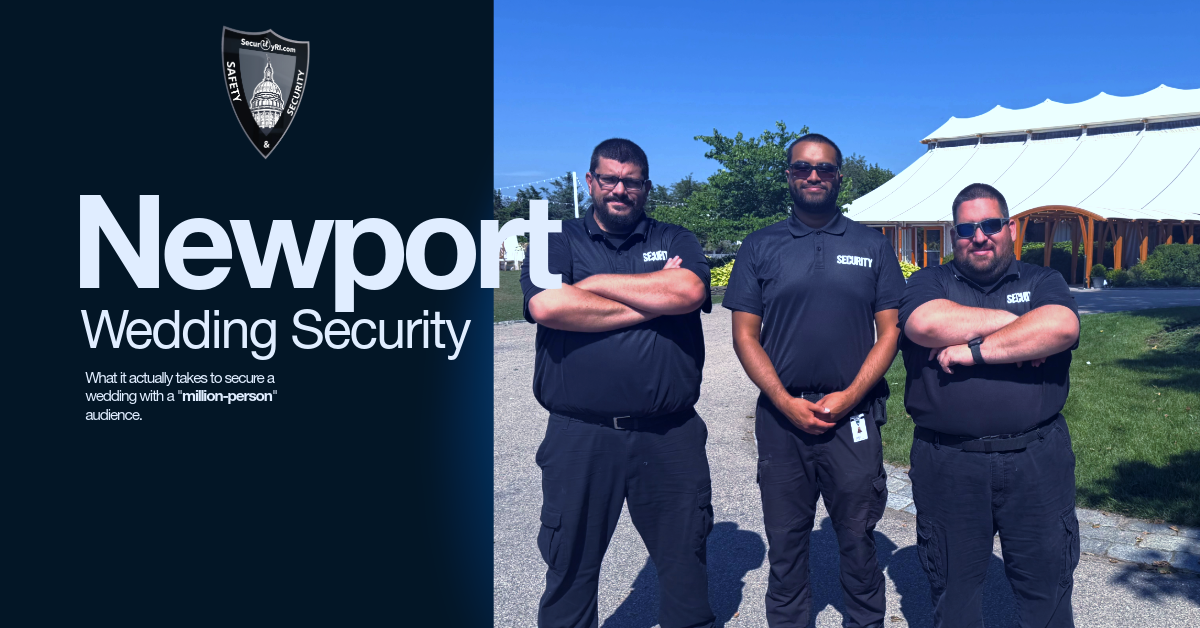
Newport, Rhode Island / Event Security
The Weekend Newport Went Viral: What It Actually Takes to Secure a Wedding With a Million-Person Audience
On Saturday, August 8, 2026, a Newport waterfront wedding became one of the most-watched private events in the country. Here is what that looks like from the security side, and what every couple planning a high-profile Rhode Island wedding should understand before they send the first invitation.
Newport hosts thousands of weddings a year. Most of them are beautiful, well run, and completely uneventful from a security standpoint. A handful are something else entirely.
On August 8, fashion creator Brigette Pheloung, known to roughly 1.1 million Instagram followers and more than 1.5 million on TikTok as Acquired Style, married Mitch McHale on the Newport waterfront. The couple had already legally married in June at Saint Joseph’s University in Philadelphia, where they met nearly a decade earlier. The Newport weekend was the celebration.
By Monday morning, the gown was on People, E! News, and a long list of fashion verticals. A photo had leaked before the couple posted anything themselves. On TikTok, creators who were not invited had driven to Newport to film white tents from public roads, and the phrase “boots on the ground journalism” was being used, mostly unironically, in captions.
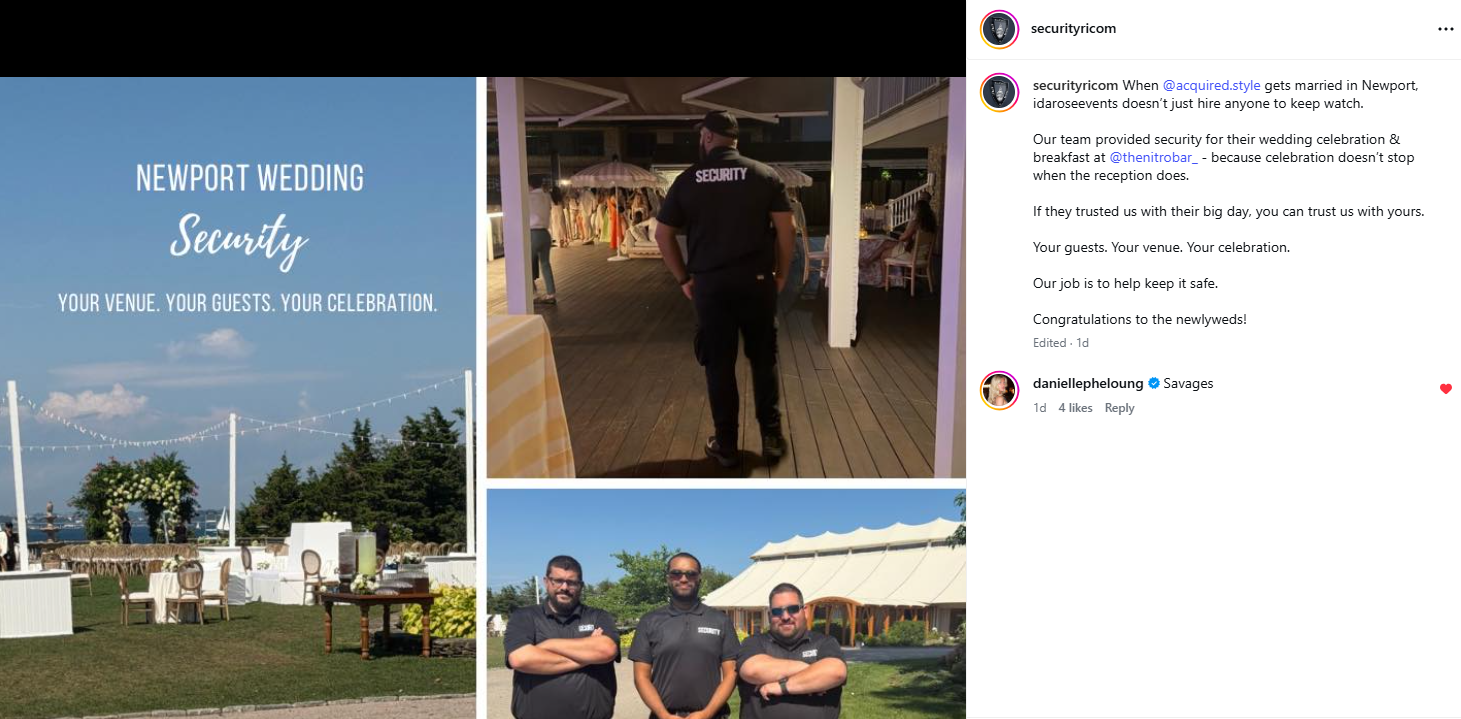
SecurityRI provided security services for the weekend. We are not going to describe how. What we can do is explain the shape of the problem, because it is a problem that more and more Rhode Island couples are quietly walking into, and almost nobody talks about it honestly.
Three venues, one town, one very busy weekend
A modern destination wedding is not an event. It is a schedule. This one moved across three distinct properties, each with completely different characteristics.
351 Thames Street. Downtown, on the harbor, next to a working marina, with public sidewalk on one side and open water on the other.
A 40-acre private peninsula off Ocean Avenue, with a historic lighthouse, long lawns, and water on three sides.
A Rhode Island coffee institution that started as a homemade cart in 2016 and now serves a private-event breakfast crowd.
The weekend was produced by Ida Rose Events, a luxury planning firm that works out of DC and New York and runs destination weddings nationally. Bringing in an out-of-market planner of that caliber is increasingly normal for Newport, and it changes the security conversation in a good way: you are working with people who have run this play before and who understand that security is a production department, not an afterthought.
Those three venues could not be more different from each other. Forty 1° North sits directly on Thames Street, which in August is one of the most heavily trafficked pedestrian corridors in the state. Castle Hill Inn is the opposite: secluded, private, and approached by a single road, but ringed by water that anyone with a boat can occupy. The morning-after breakfast was a smaller, looser, happier affair, which is its own category of risk because that is the moment everyone stops thinking about it.
The threat model is not what people assume
When most people picture wedding security, they picture a bouncer stopping a crasher at a door. That is a real job and it happens. But it is not the center of gravity at an event like this one.
At a wedding with an audience this size, the thing being protected is not the venue. It is the couple’s control over their own story.
Consider what actually happened in the days around August 8. Content creators traveled to Newport specifically to film the setup from public roads and speculate about the venue. A photograph of the dress circulated before the bride had posted anything, generating a separate news cycle about an unrelated influencer who happened to wear a similar gown. Aerial and long-lens angles of white tents were shared and dissected. None of that requires anyone to set foot on private property.
That is the modern reality. The people creating pressure on an event like this are almost never dangerous. They are enthusiastic. They are fans, hobbyist paparazzi, small creators chasing a moment, and, increasingly, other guests who are themselves professional content producers with their own audiences and their own posting schedules.
The traditional security question is “who is trying to get in.” The current question is “who is trying to get an image, from where, and what happens the second they post it.” Those require different answers, different posture, and a very different kind of officer.
Newport is a genuinely difficult town to keep quiet
We have written before about what makes Newport distinct as a security environment, and weddings sharpen every one of those factors.
The geography works against privacy
Newport’s most desirable venues are coastal, which means at least one flank is water. Narragansett Bay and the Atlantic are public. A boat sitting a few hundred yards offshore with a long lens is doing nothing wrong and cannot be moved. Ocean Avenue, the scenic loop that serves several of the region’s best estates, is a public road that thousands of tourists drive slowly every single day in August. A car slowing down near a venue is not a signal. It is Tuesday.
Peak season removes your background noise
In February, an unfamiliar vehicle parked on a quiet Newport side street is worth a second look. On the second Saturday in August, it is one of ten thousand. The volume of legitimate visitors is so high that anomaly detection, which is the foundation of most protective work, becomes much harder. You cannot look for people who do not belong when almost everyone in town is a visitor.
Single approach roads cut both ways
Several premier Newport properties are reached by one road. That is excellent for controlling access and terrible for everything else. One delivery truck, one fender bender, or one clogged intersection and your vendor load-in, your guest shuttles, and any emergency vehicle response all share the same bottleneck. Access control planning and traffic planning are the same conversation in this town, and they need to happen with the venue and the planner in the room together.
The part nobody wants to hear
A licensed security officer has no authority to stop someone from photographing your wedding from a public road, a public beach, or a boat in public water. Anyone who tells you otherwise is selling you something. What a good team can actually do is control every inch of private property, manage sightlines and staging so there is less to photograph from a distance, and make sure nothing escalates into a scene that becomes a bigger story than the wedding.
The seams are where things go wrong
The ceremony itself is the easiest part of a wedding weekend to protect. Everyone is seated, everyone is accounted for, and the perimeter is fixed. The risk lives everywhere else.
Load-in and load-out. The hours when a venue is full of florists, rental crews, caterers, lighting techs, and photographers, all of whom need access and none of whom you have met. This is the single most permeable window of the entire weekend, and it happens before anyone is thinking about security.
The welcome party. The moment the weekend goes public. A downtown venue on Thames Street means guests arriving and leaving in view of a crowded street, and it is usually the first hard confirmation to the internet of where everyone is staying.
The transitions. Movement between venues is when a controlled environment temporarily stops being controlled. Shuttle staging, valet lines, and the gap between a car door and a front door are all short but exposed.
The morning after. Everyone has relaxed. The professionals have gone home. The couple is at their most recognizable and least protected. It is also, frequently, the most photographed hour of the weekend, because it is the candid one.
What good wedding security actually looks like
Here is the standard we hold ourselves to at an event like this: if a guest can describe what security did, we did it wrong.
Wedding work is not venue work and it is not nightlife work. The officer standing near a Newport tent is not there to project force. They are there to be the calmest, most polite person on the property, and to solve about forty small problems before anyone notices there was a problem. Someone parked in the fire lane. A vendor with no credential. A guest who wandered toward the water in the dark. A person on the property line who genuinely just wants to see the lighthouse.
That last one matters more than people think. Ninety percent of the interactions at a high-profile wedding end with someone being told “no” and walking away happy. The officer who cannot do that, who escalates a curious tourist into a confrontation, has created exactly the viral moment the entire operation exists to prevent. Temperament is the single most important qualification, well ahead of size, background, or hardware.
It also means dressing for the room. An officer in tactical gear at a black-tie coastal wedding is a costume error that photographs badly and tells every guest that something is wrong. Presentation is part of the protective plan.
And it means deferring. The planner owns the timeline. The venue owns the guest experience. We work inside their structure, not across it. The best compliment a planner can give a security team is that the vendors did not notice a change in how their day ran.
If you are planning a high-profile Rhode Island wedding
You do not need a million followers for any of this to apply. A local business owner, a physician, an athlete, a politician, a family with a recognizable name, or simply a couple with 300 guests and a coastal venue will encounter some version of the same dynamics. Here is what we would tell any of them.
-
Decide early whether the venue is public information
This is the single highest-leverage decision you will make, and it has to happen before save-the-dates. Once the venue is known, everything downstream gets harder. If you want it quiet, your invitation language, your vendor contracts, and your hotel blocks all need to reflect that from day one.
-
Brief the guests, not just the staff
Your guests will out-post your security plan every time. A short, warm, specific note in the welcome materials works far better than a rule: no geotagging until the couple posts, no photos of the ceremony, and please do not share the venue location publicly. People comply when they understand why.
-
Cover the whole weekend, not just the wedding day
Rehearsal dinner, welcome party, load-in, transitions, and the morning after are where the actual exposure is. Booking coverage for eight hours on a Saturday protects the easiest part of the weekend and leaves the rest open.
-
Give your planner one security point of contact
Planners run on clean lines of communication. One named person who attends the vendor walkthrough, holds the timeline, and can be reached during the event is worth more than a larger team with no integration.
-
Book Newport far earlier than you think you need to
Newport’s summer calendar is one of the most compressed in New England. On a peak August Saturday, every reputable vendor in the region, security included, is already committed. Ninety days out is comfortable. Two weeks out on an August Saturday is a coin flip.
-
Understand what cameras can and cannot do here
Temporary surveillance is genuinely useful for perimeter awareness and load-in documentation at a large property. But it records; it does not intervene. We have written a longer breakdown of where cameras help and where they do not, and a wedding is a textbook case for why the answer is usually both.
Newport did what Newport does
For all the noise around it, the weekend of August 8 was, by every public account, a lovely wedding. A couple who met in college nine years ago got married on the water in front of the people they love, and a lot of very good Rhode Island and out-of-state vendors made it happen on time and on plan.
That is the entire point. The measure of an event like this is not the security plan. It is that nobody who was there spent a single second thinking about one.
Congratulations to Brigette and Mitch. And to Newport, which remains, for better and for worse, impossible to keep a secret.
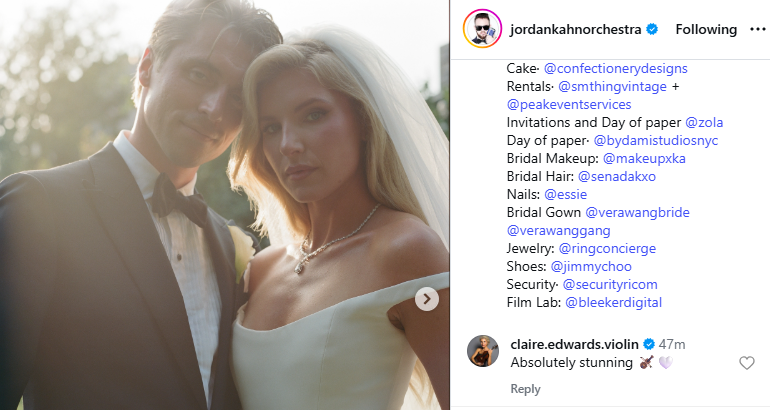
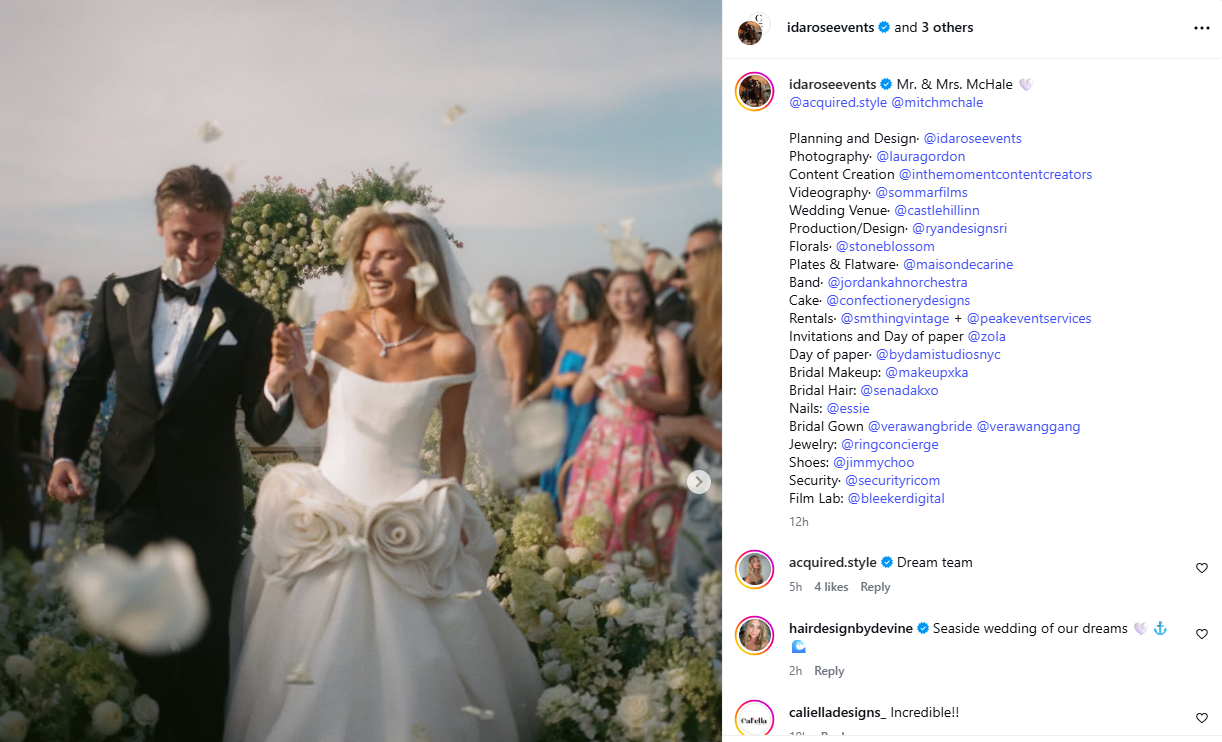
Weekend credits
- CoupleBrigette Pheloung & Mitch McHale
- Planning & DesignIda Rose Events
- Welcome PartyForty 1° North, Newport
- Ceremony & ReceptionCastle Hill Inn, Newport
- Morning AfterThe Nitro Bar
- SecuritySecurityRI.com
Frequently asked questions
Do you need security for a wedding in Newport, Rhode Island?
Most Newport weddings do not require dedicated security. It becomes worthwhile when one or more of these is true: the couple or a guest has public recognition, the guest count exceeds roughly 200, the property has open water frontage or public road access, alcohol service runs late, or the venue requires it by contract. Several Newport venues now require licensed security for events above a certain size, so the venue contract is always the first place to check.
Can wedding security stop people from photographing my event?
Not from public property. Anyone standing on a public road, public beach, or in public water has the right to photograph what they can see. Licensed officers have authority on the private property they are contracted to protect. What a security team can realistically do is control all private access points, work with the planner on staging and sightlines so there is less visible from a distance, and manage encounters so they never escalate into an incident.
How far in advance should I book event security in Newport?
For a summer Saturday, 90 days or more. Newport’s June through September calendar is extremely compressed and regional vendor availability tightens dramatically for peak weekends. Off-season and weekday events have far more flexibility. SecurityRI can typically deploy within 24 to 48 hours for shorter-notice requests, but peak Saturday availability is never guaranteed.
Should wedding security officers be armed or unarmed?
Unarmed is appropriate for the overwhelming majority of weddings, including large and high-profile ones. The work is access control, guest service, and de-escalation, and an unarmed uniformed presence fits the environment better. Armed coverage is a narrow exception driven by a specific, identified threat rather than by guest count or venue prestige.
Does SecurityRI provide event security across Newport County?
Yes. SecurityRI holds Rhode Island Security License #1, issued in 1981 and held continuously since, and provides event security throughout Newport, Middletown, Portsmouth, Jamestown, Tiverton, and Little Compton, along with the rest of Rhode Island. Dispatch operates 24/7/365 from our North Providence headquarters. Officers work under the company license, and every officer passes a BCI background check.
