Reduce Human Error in your business

Human Error: Understand the IT Threat

With over 90% of all cyber security breaches due to human error, it’s safe to say that mistakes in the workplace are more than costly. So what mishaps are your end users making, and what exactly are the repercussions to your organization? 


Many of the successful security attacks from external attackers who are preying on human weakness, waiting patiently for employees to be lured into providing access to sensitive information. Their human errors can be incredibly costly, especially since the insiders involved have access to a host of sensitive data.

One of the greatest impacts of a successful security breach is the exposure of this kind of information, loss of intellectual property and the infection of malware.

The Threat of Human Error


One of the most common mistakes made by employees, is sending sensitive documents to unintended recipients. This is relatively easy to solve when deploying security controls to monitor sensitive information being leaked from your organization.

These controls were once considered complex to deploy, but have now been made considerably easier to implement by vendors in recent years. This has dramatically reduced the level of user involvement required and increased the use of such controls.

These tools can also:

  • Prevent users from engaging in inappropriate behavior
  • Eliminate sending documents home via email, placing them on file-sharing sites or removable media such as USB sticks

See how the growing culture of bring-your-own-device (BYOD) exposes additional major concerns, especially with the risk of lost or stolen mobile devices. Again, technology vendors are available to help companies control what happens to data stored on such devices, even allowing sensitive data to be remotely wiped – so that it doesn’t fall into the wrong hands.

Even the most trusted and highly skilled employees run major risks of human error. System and network administrators are commonly guilty of incorrect system configurations, poor patch management practices and the use of default names and passwords. There are numerous security controls that organizations can explore to guard against these types of threats.

0
Read More
SecurityRI.com Internet Toy Risks

FBI Warns Parents: Your Kid’s Internet Smart Toys Could Be a Security Risk

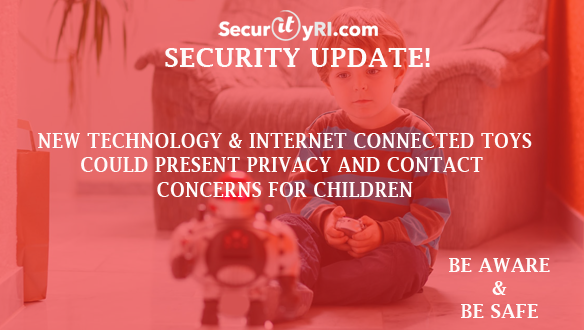
While we continue to grow as a technology driven society, so doesn’t our children’s toys. Many smart toys in 2017 connect to the internet, and even though they’re extremely popular, they may introduce security risks to your children / family. As a cyber security company we encourage our community to follow the FBI’s instructions which is the following:

Consider cyber security prior to introducing smart, interactive, internet-connected toys into their homes or trusted environments. Smart toys and entertainment devices for children are increasingly incorporating technologies that learn and tailor their behaviors based on user interactions. These toys typically contain sensors, microphones, cameras, data storage components, and other multimedia capabilities – including speech recognition and GPS options. These features could put the privacy and safety of children at risk due to the large amount of personal information that may be unwittingly disclosed. – FBI

Why Does This Matter To My Family?

The features and functions of different toys vary widely. In some cases, toys with microphones could record and collect conversations within earshot of the device. Information such as the child’s name, school, likes and dislikes, and activities may be disclosed through normal conversation with the toy or in the surrounding environment. The collection of a child’s personal information combined with a toy’s ability to connect to the Internet or other devices raises concerns for privacy and physical safety. Personal information (e.g., name, date of birth, pictures, address) is typically provided when creating user accounts. In addition, companies collect large amounts of additional data, such as voice messages, conversation recordings, past and real-time physical locations, Internet use history, and Internet addresses/IPs. The exposure of such information could create opportunities for child identity fraud. Additionally, the potential misuse of sensitive data such as GPS location information, visual identifiers from pictures or videos, and known interests to garner trust from a child could present exploitation risks.

Consumers should examine toy company user agreement disclosures and privacy practices, and should know where their family’s personal data is sent and stored, including if it’s sent to third-party services. Security safeguards for these toys can be overlooked in the rush to market them and to make them easy to use. Consumers should perform online research of these products for any known issues that have been identified by security researchers or in consumer reports.

What Makes Internet-Connected Toys Vulnerable?

Data collected from interactions or conversations between children and toys are typically sent and stored by the manufacturer or developer via server or cloud service. In some cases, it is also collected by third-party companies who manage the voice recognition software used in the toys. Voice recordings, toy Web application (parent app) passwords, home addresses, Wi-Fi information, or sensitive personal data could be exposed if the security of the data is not sufficiently protected with the proper use of digital certificates and encryption when it is being transmitted or stored.

Smart toys generally connect to the Internet either:

  • Directly, through Wi-Fi to an Internet-connected wireless access point; or
  • Indirectly, via Bluetooth to an Android or iOS device that is connected to the Internet.

This information can be breached / hacked which may fall in the hands of the unwanted.

WHAT SHOULD I DO?

The FBI encourages consumers to consider the following recommendations, at a minimum, prior to using Internet-connected toys.

  • Research for any known reported security issues online to include, but not limited to:
  • Only connect and use toys in environments with trusted and secured Wi-Fi Internet access
  • Research the toy’s Internet and device connection security measures
    • Use authentication when pairing the device with Bluetooth (via PIN code or password)
    • Use encryption when transmitting data from the toy to the Wi-Fi access point and to the server or cloud
  • Research if your toys can receive firmware and/or software updates and security patches
    • If they can, ensure your toys are running on the most updated versions and any available patches are implemented
  • Research where user data is stored – with the company, third party services, or both – and whether any publicly available reporting exists on their reputation and posture for cyber security
  • Carefully read disclosures and privacy policies (from company and any third parties) and consider the following:
    • If the company is victimized by a cyber-attack and your data may have been exposed, will the company notify you?
    • If vulnerabilities to the toy are discovered, will the company notify you?
    • Where is your data being stored?
    • Who has access to your data?
    • If changes are made to the disclosure and privacy policies, will the company notify you?
    • Is the company contact information openly available in case you have questions or concerns?
  • Closely monitor children’s activity with the toys (such as conversations and voice recordings) through the toy’s partner parent application, if such features are available
  • Ensure the toy is turned off, particularly those with microphones and cameras, when not in use
  • Use strong and unique login passwords when creating user accounts (e.g., lower and upper case letters, numbers, and special characters)
  • Provide only what is minimally required when inputting information for user accounts (e.g., some services offer additional features if birthdays or information on a child’s preferences are provided) – FBI’s Website

0
Read More

Protect Yourself When Using Social Media

Facebook, Twitter, LinkedIn, YouTube and list continues. Social Media has been the topic of discussion for some time now. In 2017, it seems everyone has become a victim to the addicting “social world”. However, do not let yourself become a different type of victim, a victim to social media fraud.

 Social Media Fraud

Social media has transformed into a hunting ground for identity thieves. If you are a cyber-criminal why wouldn’t you research for detailed information through social media? You can find many user facts, besides their social security number.

Before you continue to read our blog just think about the information you are sharing right now? Even if your account is set to “private”, cyber thieves can obtain the following personal information:

  • Full Name
  • Birth date (Don’t you want your followers to wish you a happy birthday!)
  • Home Address
  • Work Address
  • E-mail
  • Etc

Now think about this simple scenario. Say a cyber thief wants to access your bank account information. They currently have your full name, address, e-mail, etc. The only material they’re missing is your user security Q&A’s. Although, why not dig a little deeper into your profile. Say your “security questions” are regarding my cute puppy Rex. I’m always posting pictures and tagging Rex, well guess what? The cyber-criminal can crack your simple security question by searching through your recent postings. It may sound unreal, although many users do not follow the correct safety protocol. I understand many users like to make their password and security questions simple to remember.

How to Protect Yourself? 

  1. Limit the amount of personal information you post – You do not want cyber criminals sniffing around and knowing your every move. Do not allow people to understand your schedule and routine, especially strangers.
  2. Understand that the Internet is a public resource – Only post information you are comfortable with everyone seeing. This includes information, photos in your profile, blogs and other forums. Also, once you post information online, you can’t retract it. Even if you remove the information from a site, saved or cached versions may still exist on other people’s machines.
  3. Be wary of strangers – You wouldn’t allow every stranger in the world into your home, so don’t allow them to see everything on your social media page.
  4. Evaluate your settings – Take advantage to the site privacy settings. Understand the social media engine and benefit from its offerings.  Customize your profile to ensure only your close friends and family may see your post / statuses. Sites may update their settings periodically, so make sure you read / understand the revised versions.
  5. Use strong passwords / security questions – Never associate with easy to find information. Also, use special characters when choosing difficult passwords.
  6. Keep software, particularly your web browser, up to date – Install software updates so that attackers cannot take advantage of known problems or vulnerabilities.  Many operating systems offer automatic updates. If this option is available, you should enable it.
  7. Use and maintain anti-virus software – Anti-virus software helps protect your computer against known viruses, so you may be able to detect and remove the virus before it can do any damage. Because attackers are continually writing new viruses, it is important to keep your definitions up to date. Staying Safe US-Cert

Spread the Word

Hopefully, we’re able to reach our followers and help them understand the social media threats. Please enjoy your time on social media, although, be safe and smart when posting.

Feel free to share our blogs! If you have any questions contact SecurityRI at any time.

Thank you –


0
Read More

Do Not Fall Victim!

Best Practices for Cyber Security in 2017


Many individuals believe in cyber security practice, although some people do not see the threats.  Why worry about something major if it never happened to you?

Well, statistics prove how damaging cyber threats are and how they can cripple your organization.  Please take note – not all cyber protection cost money.  If you believe in proper protocol and follow through with simple updates, you may protect yourself and others from future threats.

Here you will find a few simple preventative strategies (more…)

0
Read More